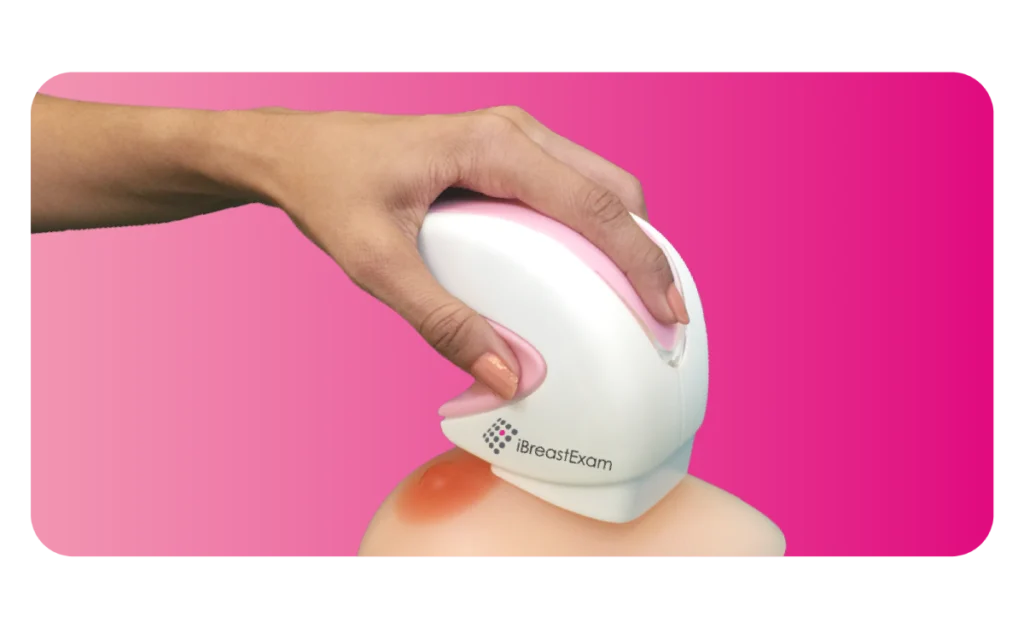
The iBreastExam uses advanced technology to detect breast cancer in its early stages, increasing the chances of successful treatment and a positive prognosis.
It helps physicians obtain a more accurate picture of the breast and detect abnormalities that might otherwise go undetected.
The iBreastExam technology is safe for women and does not use radiation, which can be an advantage for those women who have a family history of breast cancer or who have concerns about radiation exposure.

THE PATIENT

BREAST TISSUE

AND GRID

RESULTS

RESULTS
Advanced technology for breast cancer detection


25,000 women examined worldwide
7 investigator-initiated studies
*Data presented at the 2009 San Antonio Breast Cancer Symposium
The Lancet Global Health Article by Victoria Mango and colleagues used the portable iBreastExam, a handheld screening device, to evaluate women aged 40 years or older who were symptomatic or at high risk with a family history of breast cancer. They compared the iBreastExam with clinical breast examination performed by experienced surgeons and used imaging (mammography or ultrasound) as a reference standard. To our knowledge, this type of study was the first in Nigeria and possibly in Africa.
The independent review concluded that:
The iBreastExam can overcome the issue of a shortage of specialists for early detection of breast cancer in Nigerian communities, thus showing the potential to reduce incidence of advanced stage breast cancer and might lead to improvement in survival.
In conclusion, the study shows that with minimal training, inexperienced health-care providers can use the iBreastExam successfully and achieve higher sensitivity than with clinical breast examination.
Link: The Lancet Global Health | Comment | Volume 10, ISSUE 4, E461-E462, April 2022
424 Nigerian women with median age of 46 years that were either symptomatic or at high-risk for breast cancer, were enrolled.
Link: The Lancet Global Health | Articles | Volume 10, ISSUE 4, E555-E563, April 2022
It would be a win-win situation for all parties involved if the government of Nepal would seriously consider introducing, implementing, and incorporating screening examinations such as iBreastExam and other similar tools to improve early detection and reduce the undesirable and unfortunate breast cancer–related mortalities.
Diagnostic accuracy of a novel palpation device to improve early detection of breast cancer in low-resource settings
Key conclusions from an independent study in a Brazil based study of 226 women (449 breasts analyzed independently),
The relatively high specificity highlights the tools’ ability to reduce the pool of women warranting further evaluation but the sensitivity of iBE compared to mammography alone was relatively low.
15 of the 17 cases identified as normal by iBE were classified as BIRADS 0. When these cases underwent US, the net sensitivity increased to 74%.
Based on the acceptability survey, iBE shows extreme promise and demonstrates high approval among women
These data highlight the potential for iBreastExam to strengthen breast cancer early detection programs in LMIC’s and support the need for next generation sensors with improved sensitivity.
Link: SABCS Feb 2020 | Cancer Res (2020): P1-01-06
Clinical efficacy evaluation of a novel palpation imaging device for early detection of breast cancer in the developing world
1,200 asymptomatic women (2,400 breasts) with median age of 43 years were examined by clinical breast exam and iBreastExam
Study of accuracy of iBreastExam as a screening modality to detect breast lump – Experience of a tertiary care center in central India
19,583 women enrolled over 2 years by Governmental Medical College in Nagpur, India, with a mean age of 36 years. 62.42% females came for screening, 31.16% females presented with lump in the breast and 6.42% females with pain in the breast.
iBreastExam shows significantly better sensitivity and higher specificity and was found to be a promising effective tool for younger women with dense breast.
It is highly cost-effective in terms of maintenance of the device, transport of females to tertiary center, reducing patient load for physicians and workload for machines and radiologists.
iBE is the first modality providing results at point-of-care and making females anxiety free, who came for screening with normal breasts.
Link: Peer Reviewed Publication, Full Text
Prospective three-arm triple-blinded comparative study for breast cancer screening in low resource setting countries
916 healthy women visiting Manipal Hospital, Bangalore, for annual health check were recruited for bilateral breast examinations. Additionally, 20 women attending the hospital with breast-related symptoms were also recruited as part of the opportunistic screening program. Each woman was examined by three independent methods, each blinded to the other two: iBreastExam (iBE), Clinical Breast Examination (CBE) by an expert clinician and Breast Imaging (mammography or breast ultrasound).
iBreastExam) performed with significantly better sensitivity, by 19 %, than CBE to detect breast lesions while reporting high specificity (94 %) and NPV (98 %).
In younger women population under the age of 40 years, where the prevalence of dense breast is high, iBreastExam demonstrated high-performance characteristics.
iBreastExam detected all malignant lesions in this study, while the clinician’s CBE missed to detect a non-palpable malignant lesion.
iBreastExam can be a promising tool to provide clinically effective and standardized breast examinations in low-resource settings to detect breast lesions at early stages. The device can also be an effective screening tool for younger women with dense breasts.
Link: Peer Reviewed Publication, Full Text
A cost-effective handheld breast scanner for use in low-resource environments: a validation study
Independent clinical study published in the World Journal of Surgical Oncology in Oct 2016. iBreastExam correctly identified 66 lesions demonstrating sensitivity of 86% and specificity of 89%.