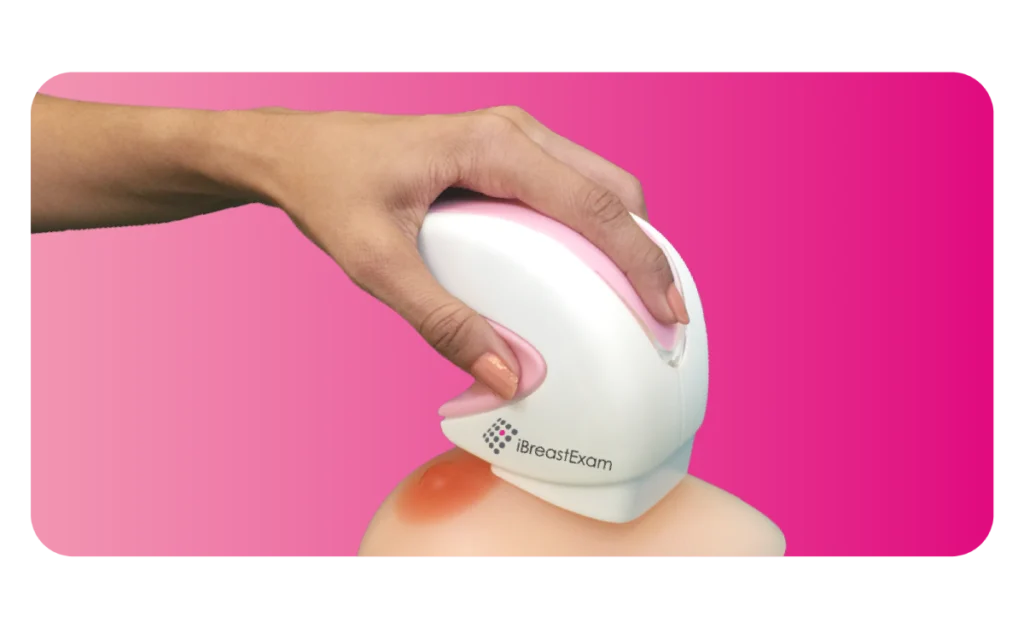
iBreastExam for Healthcare Professionals

Characterizes and quantifies the stiffness of lesions in breast tissue
Mujer afro sonriendo

How does iBreastExam work?

The iBreastExam uses advanced technology to detect breast cancer in its early stages, increasing the chances of successful treatment and a positive prognosis.

It helps physicians obtain a more accurate picture of the breast and detect abnormalities that might otherwise go undetected.

The iBreastExam technology is safe for women and does not use radiation, which can be an advantage for those women who have a family history of breast cancer or who have concerns about radiation exposure.

1

Breast lumps

Breast lumps (lesions) are stiffer than healthy breast tissue. The difference in their tissue elasticity is measurable.
2

Mechanical Imaging

The iBreastExam’s dynamic coplanar capacitive sensors measure these changes in real time, digitally and non-invasively.
3

Detection

iBreastExam standardizes the detection of lumps with minimal training and no interpretation by the user.
4

Documentation

Quick and painless documentation of routine breast exams informs and empowers both medical professionals and women.

iBreastExam creates a detailed map of the breast and detects potential areas of concern

Aplicacion ibreastexaml imagen

Benefits of iBreastExam

icono Check

Convenience

The iBreastExam is a portable, easy-to-use device that can be performed anytime, anywhere.
Women ICON 3

Accessibility

This device can be an affordable and accessible option for women who cannot afford a mammogram or who live in areas with limited access to medical services.
Icono mama con cuadros

Advanced Technology

The iBreastExam uses state-of-the-art technology to provide a detailed image of the breast and detect any abnormalities early.
Logo mujer con chulo

Comfort

This device has no radiation and is completely painless, which may be important for some women.

Step by step

icono paso numero 1

Register and prepare

THE PATIENT

icono paso numero 2

Scanning the

BREAST TISSUE

icono paso numero 3

Understanding the map

AND GRID

icono paso numero 4

Execute and rectify

RESULTS

icono paso numero 5

Share

RESULTS

iBreastExam Features

Advanced technology for breast cancer detection

25,000 women examined worldwide

7 investigator-initiated studies

Specificity 91%

Sensitivity 86%
NPV 98%

*Data presented at the 2009 San Antonio Breast Cancer Symposium

Our Global Advisors

Ari Brooks, MD, FACS

Chief Medical Advisor and Clinical PI | U.S.A.
Dr. Brooks is Director of Endocrine and Oncologic Surgery and Director of the Pennsylvania Hospital Integrated Breast Center. As a clinical investigator, Dr. Brooks has over 60 publications and remains the principal investigator on numerous translational research grants. He is a former director of the Surgical Research and Translational Bioengineering Laboratory at Drexel University.
foto doctor brian englander

Dr. Brian Englander

Medical Imaging Consultant and Clinical PI | U.S.A.
Dr. Englander is Chairman of the Department of Radiology at Pennsylvania Hospital, specializing in breast cancer imaging. He is the 2018 Eisenhower Fellow and his research interests focus primarily on the use of imaging modalities for breast cancer detection and diagnosis. In August 2018, he provided an in-depth interview to The New York Times in an opinion piece, "New Way to Detect Breast Cancer" to discuss UELS' iBreastExam innovation.

Romeu Domingues, MD

Medical Imaging Advisor | Brazil
Dr. Domingues is a global radiology thought leader from Brazil and the Chairman of DASA, the largest diagnostics company in Latin America with 20,000 employees, over 2,000 doctors and performs tens of millions of medical exams each year.

Mauricio Costa, MD

Clinical PI & Advisor | Brazil
Dr. Costa is the Breast Surgeon President-elect of the Senologic International Society Office Council International Gynecologic Cancer Society. He is Chief of the Gynecological Oncology Sector of HUCFF, Brazil from 1987 to 2016, Chairman of the Board of Medical Center Americas Medical City and the Director of the Section of Mastology of the Brazilian College of Surgeons.
Foto de el doctor benjamin anderson

Benjamin Anderson, MD, FACS

Scientific/Research Advisor | USA
Dr. Anderson is an internationally recognized leader in global cancer control. He is the founder of the Breast Health Global Initiative (BHGI), a unique program to develop “resource-stratified” guidelines for breast cancer control LMICs. Dr. Anderson serves on the Board of Directors of the Union for International Cancer Control (UICC) and co-chairs the Breast Cancer Initiative 2.5 (BCI2.5), a global campaign to reduce disparities in breast cancer outcomes for 2.5 million women.

Anne F. Rositch, PhD

Scientific/Research Advisor | USA
Dr. Anne F. Rositch is an applied epidemiologist, concentrating on cancer in women and global cancer disparities and conducting international field-based research. For over ten years, her research has focused on cervical cancer in HIV-positive individuals, aging women, and in low-resource settings. Her recent work is focused on identifying novel multidisciplinary and multilevel approaches for breast cancer control in LMICs.
dr baskies

Arnold Baskies, MD, FACS

Medical Advisor | USA
A highly decorated onco-surgeon, Dr. Arnold Baskies is the Past Chairman of the National Board of Directors of the American Cancer Society and has been involved with the American Cancer Society for over 37 years. He also serves on the Board of Directors of the American Society of Breast Surgeons since 2017.

Independent Global Validations

The Lancet Global Health Article by Victoria Mango and colleagues used the portable iBreastExam, a handheld screening device, to evaluate women aged 40 years or older who were symptomatic or at high risk with a family history of breast cancer. They compared the iBreastExam with clinical breast examination performed by experienced surgeons and used imaging (mammography or ultrasound) as a reference standard. To our knowledge, this type of study was the first in Nigeria and possibly in Africa.

The independent review concluded that:

The iBreastExam can overcome the issue of a shortage of specialists for early detection of breast cancer in Nigerian communities, thus showing the potential to reduce incidence of advanced stage breast cancer and might lead to improvement in survival.
In conclusion, the study shows that with minimal training, inexperienced health-care providers can use the iBreastExam successfully and achieve higher sensitivity than with clinical breast examination.
Link: The Lancet Global Health | Comment | Volume 10, ISSUE 4, E461-E462, April 2022

424 Nigerian women with median age of 46 years that were either symptomatic or at high-risk for breast cancer, were enrolled.

  • iBreastExam by recent nursing school graduates has shown a high NPV and sensitivity for identifying women with suspicious breast lesions, as defined by imaging, but lower specificity than a surgeon’s clinical breast examination.
  • In geographical locations where clinical breast examination by experienced practitioners is unavailable, the iBreastExam might fill this gap by providing a high sensitivity breast evaluation tool in the community health setting.

Link: The Lancet Global Health | Articles | Volume 10, ISSUE 4, E555-E563, April 2022

It would be a win-win situation for all parties involved if the government of Nepal would seriously consider introducing, implementing, and incorporating screening examinations such as iBreastExam and other similar tools to improve early detection and reduce the undesirable and unfortunate breast cancer–related mortalities.

Link: DOI: 10.1200/GO.22.00216 JCO Global Oncology no. 8 (2022) e2200216. Published online September 1, 2022.

Diagnostic accuracy of a novel palpation device to improve early detection of breast cancer in low-resource settings

Key conclusions from an independent study in a Brazil based study of 226 women (449 breasts analyzed independently),

The relatively high specificity highlights the tools’ ability to reduce the pool of women warranting further evaluation but the sensitivity of iBE compared to mammography alone was relatively low.
15 of the 17 cases identified as normal by iBE were classified as BIRADS 0. When these cases underwent US, the net sensitivity increased to 74%.
Based on the acceptability survey, iBE shows extreme promise and demonstrates high approval among women
These data highlight the potential for iBreastExam to strengthen breast cancer early detection programs in LMIC’s and support the need for next generation sensors with improved sensitivity.
Link: SABCS Feb 2020 | Cancer Res (2020): P1-01-06

Clinical efficacy evaluation of a novel palpation imaging device for early detection of breast cancer in the developing world

1,200 asymptomatic women (2,400 breasts) with median age of 43 years were examined by clinical breast exam and iBreastExam

  • Compared to Clinical Breast Exam, iBreastExam demonstrated significantly (23%) higher sensitivity and moderately (9%) higher specificity to detect breast lesions.
  • Given that iBE requires minimal training and provides objective breast examination with digital documentation; better performance than clinical exam highlights the tools’ utility as a triaging tool by identifying women in need for follow-up diagnostics.
  • iBreastExam may enable community health worker led triaging to detect clinically relevant breast lesions in LMIC settings.
    Link: SABCS Feb 2020 | Cancer Res (2020): P1-01-01

Study of accuracy of iBreastExam as a screening modality to detect breast lump – Experience of a tertiary care center in central India

19,583 women enrolled over 2 years by Governmental Medical College in Nagpur, India, with a mean age of 36 years. 62.42% females came for screening, 31.16% females presented with lump in the breast and 6.42% females with pain in the breast.

iBreastExam shows significantly better sensitivity and higher specificity and was found to be a promising effective tool for younger women with dense breast.
It is highly cost-effective in terms of maintenance of the device, transport of females to tertiary center, reducing patient load for physicians and workload for machines and radiologists.
iBE is the first modality providing results at point-of-care and making females anxiety free, who came for screening with normal breasts.
Link: Peer Reviewed Publication, Full Text

Prospective three-arm triple-blinded comparative study for breast cancer screening in low resource setting countries

916 healthy women visiting Manipal Hospital, Bangalore, for annual health check were recruited for bilateral breast examinations. Additionally, 20 women attending the hospital with breast-related symptoms were also recruited as part of the opportunistic screening program. Each woman was examined by three independent methods, each blinded to the other two: iBreastExam (iBE), Clinical Breast Examination (CBE) by an expert clinician and Breast Imaging (mammography or breast ultrasound).

iBreastExam) performed with significantly better sensitivity, by 19 %, than CBE to detect breast lesions while reporting high specificity (94 %) and NPV (98 %).
In younger women population under the age of 40 years, where the prevalence of dense breast is high, iBreastExam demonstrated high-performance characteristics.
iBreastExam detected all malignant lesions in this study, while the clinician’s CBE missed to detect a non-palpable malignant lesion.
iBreastExam can be a promising tool to provide clinically effective and standardized breast examinations in low-resource settings to detect breast lesions at early stages. The device can also be an effective screening tool for younger women with dense breasts.
Link: Peer Reviewed Publication, Full Text


A cost-effective handheld breast scanner for use in low-resource environments: a validation study

Independent clinical study published in the World Journal of Surgical Oncology in Oct 2016. iBreastExam correctly identified 66 lesions demonstrating sensitivity of 86% and specificity of 89%.

Link: Peer Reviewed Publication, Full Text